

Running an MSP today is no small feat, especially in a market where local U.S.-based L2 and L3 engineers are increasingly cost-prohibitive. The frustration of this talent shortage is real, making the search for global talent a strategic necessity rather than just a simple cost-saving measure.
To successfully scale and support your clients, you need to transition from traditional ticket-only outsourcing toward integrating dedicated, high-fidelity technical resources directly into your internal infrastructure.
This operational shift relies on the team extension model. Rather than settling for a disconnected Help-Desk-as-a-Service (HDaaS), you can build an offshore team that truly mirrors your company culture. Positioning the Philippines as your primary hub will allow you to leverage a workforce fluent in Western IT standards, including ITIL-certified professionals.
Ready to see how this integration looks in practice? Here’s the blueprint to make it happen.
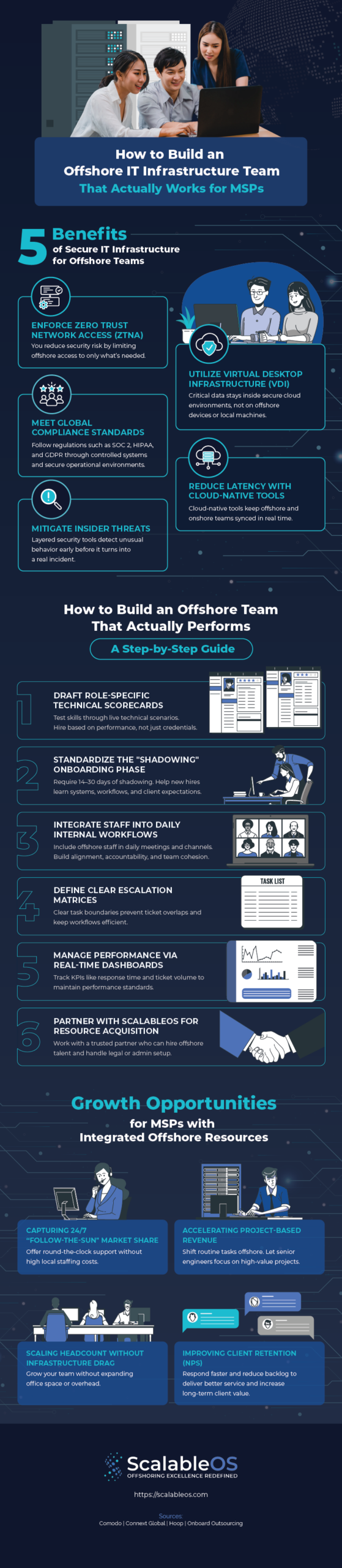
5 Benefits of Secure IT Infrastructure for Offshore Teams
When you integrate remote talent, security cannot be an afterthought. The benefits of a secure IT infrastructure for offshore teams go far beyond basic firewall protection; they ensure operational continuity and client trust.
1. Enforce Zero Trust Network Access (ZTNA)
The foundation of modern security is the assumption that no user is inherently trusted. With strict identity-based access controls, offshore resources can access only the client environments required for their active tickets.
This granular control means that if a technician is working on a specific client issue, they’re geographically and digitally fenced into that environment alone. It significantly reduces the blast radius of any potential compromise and aligns perfectly with modern security best practices.
2. Utilize Virtual Desktop Infrastructure (VDI)
Data sovereignty is a major concern for MSPs. Providing secure, high-speed virtual environments (like Azure Virtual Desktop) prevents sensitive client data from ever being stored on offshore hardware.
The actual computing power and data storage remain safely within your controlled cloud environment, while the offshore technician merely receives the visual output. This setup makes managing a remote workforce safer and easier to audit.
3. Meet global compliance standards
Clients expect their managed IT service provider to uphold rigorous compliance. To satisfy SOC 2, HIPAA, and GDPR requirements, you can host offshore talent in audited, physically secure facilities with 24/7 monitoring.
These physical safeguards maintain compliance not just at the software level but also at the facility level, passing any rigorous third-party audits your clients demand.
4. Reduce latency with cloud-native tools
Communication delays can kill an MSP’s efficiency. Deploying cloud-based RMM (Remote Monitoring and Management) and PSA (Professional Services Automation) tools allows for seamless, real-time synchronization between onshore leadership and offshore execution.
This synchronicity helps update ticket statuses instantly, preventing duplicated efforts and giving clients accurate updates regardless of where the technician resolving their issue is located.
5. Mitigate insider threats
Even with vetted talent, implementing robust endpoint detection and response (EDR) alongside multi-factor authentication (MFA) is vital to create a “locked-down” digital perimeter for remote resources.
These tools check for behavioral anomalies and secure login procedures, guaranteeing that the people accessing your systems are exactly who they claim to be, thereby neutralizing potential insider threats before they escalate.
How to Build an Offshore Team That Actually Performs: A Step-by-Step Guide
After setting up a secure perimeter, the next step is execution. Follow this guide to build a high-performing offshore extension.
1. Draft role-specific technical scorecards
General interviews are insufficient for technical roles. Creating rigorous vetting criteria for help desk talent that includes live labs for network troubleshooting and server administration means you’re hiring actual skill, not just a good resume.
Assessing them in simulated environments accurately predicts how they will perform when real client systems are on the line. To find the right service desk L2 support, thorough vetting is non-negotiable.
2. Standardize the “shadowing” onboarding phase
Don’t hand over the keys on day one. All new resources should shadow onshore leads for 14–30 days. This critical period gives them time to master specific client documentation styles and understand nuances of internal communication. It builds confidence and familiarizes them with the unique operational quirks of your client base.
3. Integrate staff into daily internal workflows
Siloed teams fail. Hence, include your offshore talent in daily Scrum huddles, centralized Slack or Teams channels, and quarterly strategy sessions to foster a true one-team mentality. When offshore technicians feel like a core part of the company culture, their accountability and proactive engagement rise substantially.
4. Define clear escalation matrices
Establishing firm boundaries between offshore L1/L2 tasks and onshore L3 projects can maintain high first-call resolution (FCR) rates. When tickets don’t bounce back and forth needlessly, you streamline workflows so senior engineers stay focused on complex issues.
5. Manage performance via real-time dashboards
You can’t manage what you do not measure. Utilize live KPI tracking for metrics like average response time (ART) and ticket churn to make offshore output match local benchmarks. Regularly reviewing IT support KPIs and help desk metrics allows you to course-correct in real time before client satisfaction drops.
6. Partner with ScalableOS for resource acquisition
Don’t navigate international hiring alone. Leverage ScalableOS—a leading outsourcing company in the Philippines—to find dedicated help desk resources who function as direct employees of your MSP, rather than a generic third-party service. This partnership lets you access top-tier talent without the administrative headaches of setting up a legal entity.
Growth Opportunities for MSPs with Integrated Offshore Resources
Once your secure, vetted team is in place, the operational possibilities expand dramatically. Integrating offshore talent opens several strategic growth avenues.
1. Capturing 24/7 “follow-the-sun” market share
Clients increasingly demand continuous coverage. Offshore teams offer round-the-clock support to high-value global clients without the prohibitive cost of local night-shift differentials. Your business can resolve issues overnight, so clients can wake up to zero downtime.
2. Accelerating project-based revenue
High-volume “noise” tickets often bog down expensive local talent. Offloading these repetitive tasks to offshore talent means onshore senior engineers can focus strictly on high-margin infrastructure migrations and vCISO services. This setup maximizes the output of your highest-paid staff and directly boosts profitability.
3. Scaling headcount without infrastructure drag
Growth usually requires physical expansion, but not with offshore teams. You can quickly increase your technical capacity without additional local office space or expensive benefits packages. This agile scaling of MSP operations with offshore teams will let you take on larger client contracts without significantly increasing overhead.
4. Improving client retention (NPS)
Service speed is the backbone of client satisfaction. Having an extended team can eliminate overnight ticket backlogs and provide faster response times during peak hours. A better net promoter score (NPS) means longer contracts and increased lifetime value per client.
This team extension model scales successfully across multiple industries. For example, businesses hire Filipino accountants to achieve the same operational leverage outside of IT.
Stop Patching, Start Integrating
It’s clear that the most successful MSPs today are those that treat offshore talent as a core, non-negotiable part of the infrastructure. There’s immense value in having dedicated help desk talent that grows with your business, understands your culture, and masters your processes, rather than relying on a stagnant, unpredictable “as-a-service” patch.
Take the time to audit your current ticket bottlenecks and identify the specific roles that are ripe for offshore integration. Are your senior engineers drowning in password resets? Is your overnight queue overflowing? Don’t let talent shortages hold back your growth. Consult with ScalableOS to build a high-performance, secure, and scalable IT infrastructure team today.
Contact us today, and start building your offshore team.